

A Scoping Review of Culturally Adapted Mental Health and Behavioral Health Interventions for Latino Youth
Updated: Nov 19, 2025

In November 2025, Abby Miller presented the results of a scoping review on culturally-adapted mental health interventions for Latino youth at the annual convention of the Association for Behavioral and Cognitive Therapies. A summary of that presentation and the handout below.
Introduction
Latino youth experience disproportionate mental health needs. Evidence shows that culturally adapted interventions—when core components are maintained—improve clinical outcomes and acceptability (Benish et al., 2011; Griner & Smith, 2006). Bernal’s Ecological Validity Framework (1995) guides cultural adaptation by aligning interventions with clients’ contexts across eight dimensions: language; persons; metaphors; content; concepts; goals; methods; and context.
Current Study
We conducted a scoping review of 15 studies implementing culturally adapted mental and behavioral health interventions for Latino youth, focusing on adaptation strategies, settings, program features, participants, and outcomes.
Method
We searched the PsycInfo and PubMed databases using the following search terms: (Latin OR Hispan) AND (“social OR emotion* OR behavior*”) AND (child* OR youth* OR adolescent* OR teen* OR student*) AND (program* OR curricul*) AND (“culturally adapted”) NOT (“substance abuse”) AND (effect* OR assess* OR outcome* OR result* OR finding*) AND (cultur*) AND (experimental OR random* OR control* OR “intervention group” OR “treatment group”)
We then applied the following inclusion criteria to the search results:
Latino youth ≤18 years old
Intervention included ≥1 cultural adaptation domain (language, persons, metaphors, goals, methods, context)
Participants were ≥ 75% Latinx.
Quantitative group-design outcomes (e.g., RCTs, clustered, pre-post).
We excluded studies that exclusively focused on interventions for substance abuse because those programs are typically delivered in clinical settings and our focus was on programs that could be conceivably delivered in schools.
Results
A flowchart of our article search and selection process is below:

Fifteen articles were ultimately retained for the present review. A list of references is provided below, and a table summarizing their content can be downloaded here:
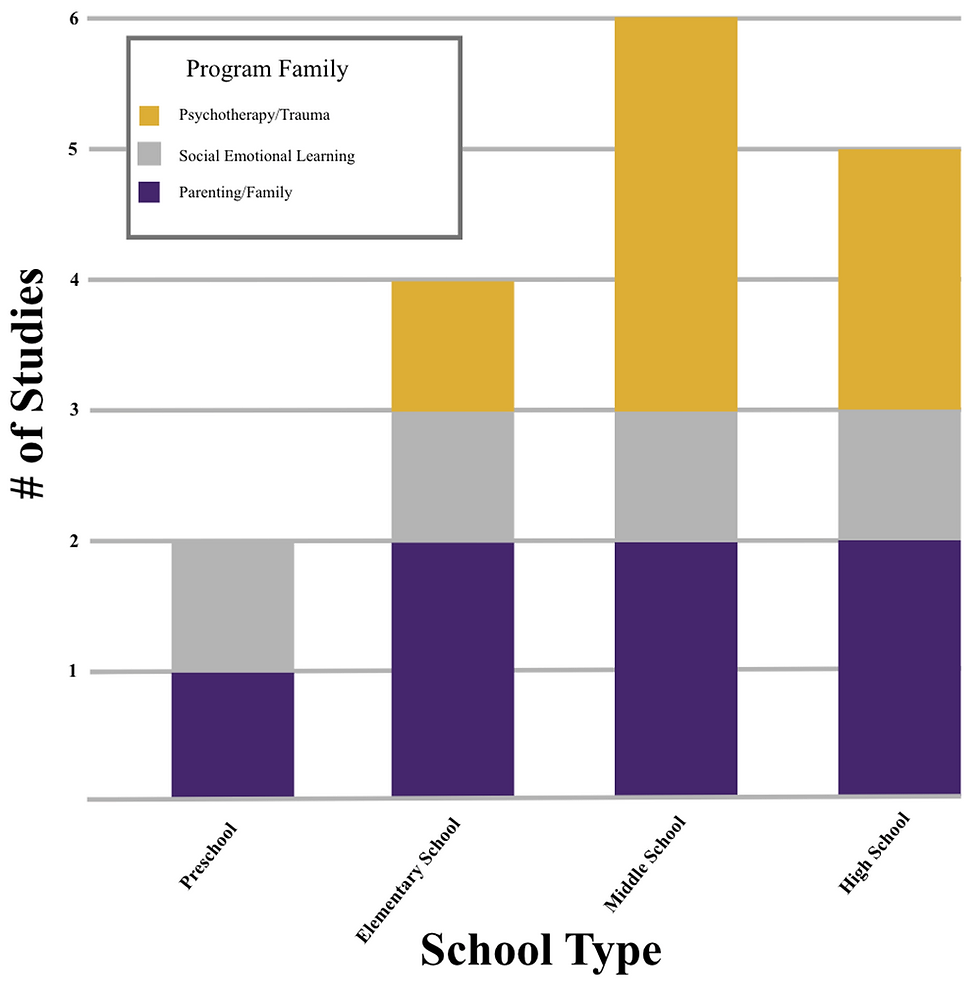
Within those articles, we first examined the type of intervention (i.e., psychotherapy, social-emotional learning, or parent program) and the school-level of the target child. A graph of those results below:
Then we examined the specific cultural adaptations used within each of the programs, based on the definitions provided by Bernal (1995). Those results are below:

Discussion
Culturally-adapted interventions have been shown to improve mental health, behavioral outcomes, and parent–child functioning for Latino youth. Many interventions use deeper structural adaptations that align with Bernal’s Ecological Validity Framework, suggesting that cultural tailoring can occur without losing fidelity. As shown in Figure 2, most interventions target middle and high school students, with very few developed for preschool or elementary-aged youth. This limits understanding across developmental stages, especially given that most studies include only short-term follow-up. As shown in Figure 3, adaptations involving language, metaphors, persons, goals, and methods were most common, while partnerships with families, partnerships with communities, and staff training appear less often.
We also found that implementation reporting is inconsistent, with limited information on facilitator training, fidelity monitoring, and barriers to adoption. Many studies also use measures not validated for Spanish-speaking or bilingual youth, making it difficult to determine whether outcomes reflect true improvement. We believe these patterns highlight the need for research with younger children, clearer implementation reporting, longer-term follow-up, culturally appropriate assessment tools, and testing scalable delivery models (e.g., telehealth, school–community partnerships).
Handout for this presentation here:
Studies Included in this Review: Allison, A. C., & Ferreira, R. J. (2017). Implementing Cognitive Behavioral Intervention for Trauma in Schools (CBITS) with Latino Youth. Child & Adolescent Social Work Journal, 34(2), 181–189. https://doi.org/10.1007/s10560-016-0486-9
Brown, J. A., Jimerson, S. R., Dowdy, E., Gonzalez, V., & Stewart, K. (2012). Assessing the effects of school-wide Second Step implementation in a predominately English language learner, low SES, Latino sample. Psychology in the Schools, 49(9), 864–875. https://doi.org/10.1002/pits.21639
Cardemil, E. V., Reivich, K. J., & Seligman, M. E. P. (2002). The Prevention of Depressive Symptoms in Low-Income Minority Middle School Students. Prevention & Treatment, 5(1). https://doi.org/10.1037/1522-3736.5.1.58a
Castro-Olivo, S. M. (2014). Promoting Social-Emotional Learning in Adolescent Latino ELLs: A Study of the Culturally Adapted Strong Teens Program. School Psychology Quarterly, 29(4), 567–577. https://doi.org/10.1037/spq0000055
Castro-Olivo, S. M., & Merrell, K. W. (2016). Validating cultural adaptations of a school-based social-emotional learning programme for use with Latino immigrant adolescents. Informa UK Limited. https://doi.org/10.1080/1754730x.2012.689193
Fung, M. P., & Fox, R. A. (2014). The Culturally-Adapted Early Pathways Program for Young Latino Children in Poverty: A Randomized Controlled Trial. Journal of Latina/O Psychology, 2(3), 131–145. https://doi.org/10.1037/lat0000019
Gonzales, N. A., Dumka, L. E., Millsap, R. E., Gottschall, A., McClain, D. B., Wong, J. J., Germán, M., Mauricio, A. M., Wheeler, L., Carpentier, F. D., & Kim, S. Y. (2012). Randomized Trial of a Broad Preventive Intervention for Mexican American Adolescents. Journal of Consulting and Clinical Psychology, 80(1), 1–16. https://doi.org/10.1037/a0026063
Hoskins, D., Duncan, L. G., Moskowitz, J. T., & Ordóñez, A. E. (2018). Positive Adaptations for Trauma and Healing (PATH), a Pilot Study of Group Therapy with Latino Youth. Psychological Trauma, 10(2), 163–172. https://doi.org/0.1037/tra0000285
Martinez Jr, C. R., Eddy, J. M., McClure, H. H., & Cobb, C. L. (2022). Promoting Strong Latino Families Within an Emerging Immigration Context: Results of a Replication and Extension Trial of a Culturally Adapted Preventive Intervention. Prevention Science, 23(2), 283–294. https://doi.org/10.1007/s11121-021-01323-7
McCabe, K., Yeh, M., Lau, A., & Argote, C. B. (2012). Parent-Child Interaction Therapy for Mexican Americans: Results of a Pilot Randomized Clinical Trial at Follow-up. Behavior Therapy, 43(3), 606–618. https://doi.org/10.1016/j.beth.2011.11.001
Pantin, H., Prado, G., Lopez, B., Huang, S., Tapia, M. I., Schwartz, S. J., Sabillon, E., Brown, C. H., & Branchini, J. (2009). A Randomized Controlled Trial of Familias Unidas for Hispanic Adolescents with Behavior Problems. Psychosomatic Medicine, 71(9), 987–995. https://doi.org/10.1097/PSY.0b013e3181bb2913
Parra-Cardona, J. R., Bybee, D., Sullivan, C. M., Rodríguez, M. M. D., Dates, B., Tams, L., & Bernal, G. (2018). Examining the impact of differential cultural adaptation with Latina/o immigrants exposed to adapted parent training interventions. American Psychological Association (APA). https://doi.org/10.1037/ccp0000160
Parra-Cardona, R., Fuentes-Balderrama, J., Vanderziel, A., López-Zerón, G., Domenech Rodríguez, M. M., Degarmo, D. S., & Anthony, J. C. (2023). A Culturally Adapted Parenting Intervention for Mexican-Origin Immigrant Families with Adolescents: Integrating Science, Culture, and a Focus on Immigration-Related Adversity. Springer Science and Business Media LLC. https://doi.org/10.1007/s11121-021-01317-5
Rosselló, J., Bernal, G., & Rivera-Medina, C. (2008). Individual and Group CBT and IPT for Puerto Rican Adolescents with Depressive Symptoms. Cultural Diversity & Ethnic Minority Psychology, 14(3), 234–245. 10.1037/1099-9809.14.3.234
Smokowski, P. R., & Bacallao, M. (2009). Entre Dos Mundos/Between Two Worlds Youth Violence Prevention: Comparing Psychodramatic and Support Group Delivery Formats. Small Group Research, 40(1), 3–27. https://doi.org/10.1177/1046496408326771
References
Benish, S. G., Quintana, S., & Wampold, B. E. (2011). Culturally adapted psychotherapy and the legitimacy of myth: a direct-comparison meta-analysis. Journal of Counseling Psychology, 58(3), 279–289. https://doi.org/10.1037/a0023626
Bernal, G., Bonilla, J., & Bellido, C. (1995). Ecological validity and cultural sensitivity for outcome research: issues for the cultural adaptation and development of psychosocial treatments with Hispanics. Journal of Abnormal Child psychology, 23(1), 67–82. https://doi.org/10.1007/BF01447045
Griner, D., & Smith, T. B. (2006). Culturally adapted mental health intervention: A meta-analytic review. Psychotherapy, 43(4), 531–548. https://doi.org/10.1037/0033-3204.43.4.531
ACKNOWLEDGEMENTS
Special thanks to Dr. Castro-Olivo of Florida International University for her longstanding work supporting Latino ELL students and for providing guidance that informed this project.


Comments